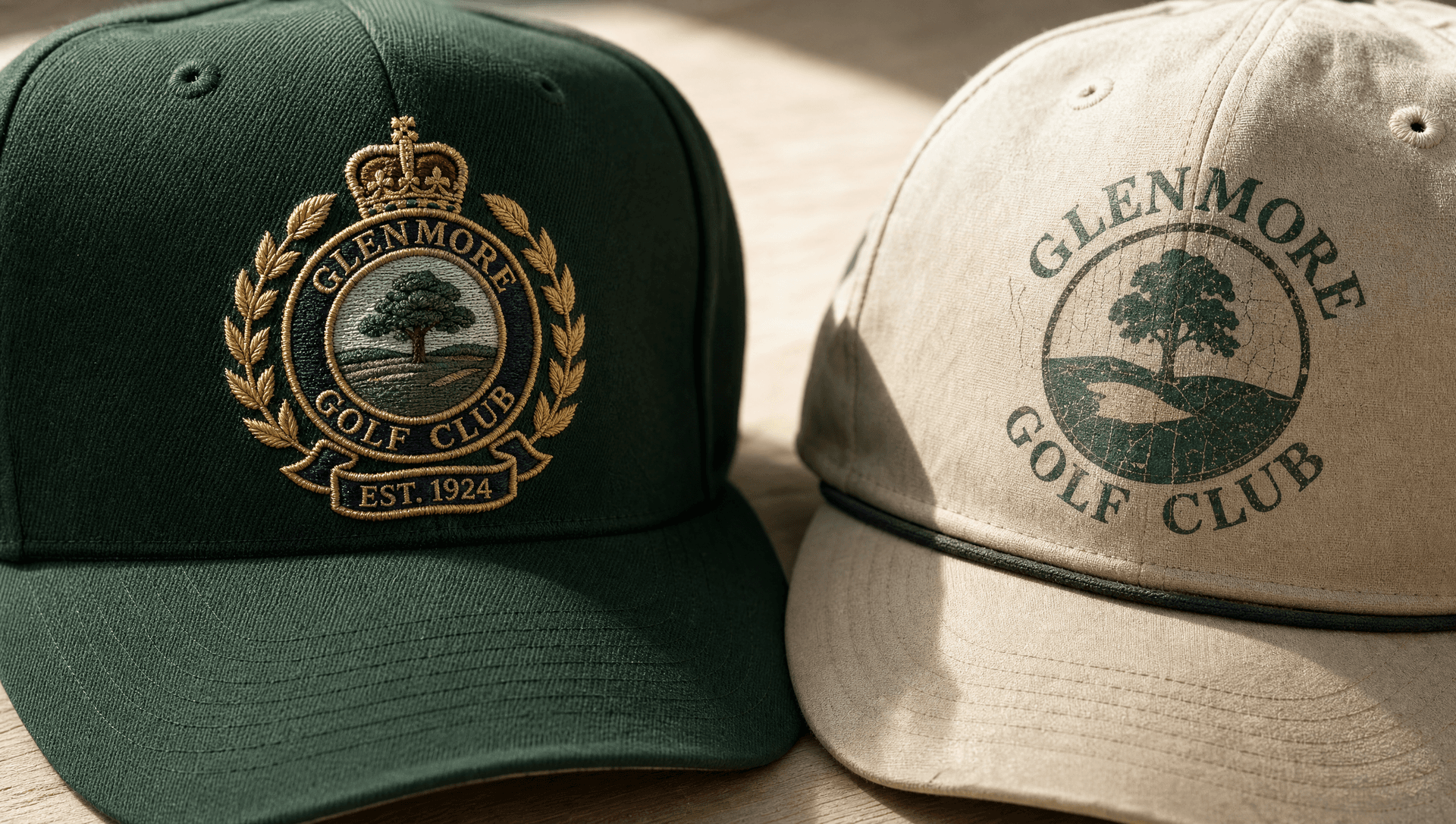
If you are deciding between embroidery and print for your pro shop's next cap run, here is the short version: embroidery. The rest of this article explains why, and the one narrow case where print is the legitimate call.
The decoration method matters more than most buyers realise at the brief stage. Embroidery and print produce fundamentally different results — in appearance, durability and perceived value. For a cap retailing at $59–$79, only one of them justifies the price tag.
What embroidery actually is
Embroidery is thread stitched directly into the fabric in multiple layers. A properly digitised design uses thousands of individual stitches to recreate your club logo in raised, three-dimensional form. The thread is colourfast — it does not fade or peel because it is not a surface application, it is woven into the cap itself. Run the design through 50 wash cycles and it still looks the same as day one.
The digitisation step — converting artwork into a stitch file — is where the quality difference is made. A poorly digitised file produces flat, puckered embroidery with incorrect thread density. A well-digitised file produces embroidery with depth, clean edges and the right stitch direction for each element of the logo. This is a craft skill, not a software export.
What print actually is
Direct-to-garment print and heat-transfer print both apply ink or vinyl to the surface of the cap fabric. Print is faster to set up, requires no digitisation and handles photographic or full-colour artwork that embroidery cannot reproduce exactly. For a custom cap ordered in small quantities, print is almost always cheaper.
The trade-off is durability and feel. Printed logos sit on top of the fabric rather than through it. Over time — and faster with regular use — they crack, peel and fade. Heat-transfer vinyl is particularly prone to lifting at the edges after washing. The cap that looked sharp on delivery day reads as promotional gear by the end of the first season.
Why embroidery wins for club merchandise
The argument for embroidery in a pro shop context comes down to four things:
- Wash durability. Your members wear their club cap frequently and wash it regularly. Embroidery holds its quality through this. Print does not.
- Perceived quality. Embroidery signals craft. Print signals a budget decision. At $69 retail, the cap needs to feel like it costs $69. Embroidery delivers that feel. Print undermines it.
- Off-course wearability. The test of a good club cap is whether a member wears it somewhere other than the club. Embroidered caps cross that threshold. A printed logo that is cracking after three months does not.
- Photography and social media. Embroidery photographs well — the texture is visible and adds depth to the image. A flat printed logo reads as flat in every medium.
The member who gets asked at another club where they got their cap is the best marketing your pro shop programme has. That moment only happens when the cap is genuinely good. It does not happen with a printed logo that has started lifting.
When print makes sense
Print is the right choice for one specific use case: event caps with complex full-colour artwork where photographic accuracy matters more than longevity. A tournament cap with a gradient or photographic element — made for one event, not for the pro shop shelf — is a legitimate application for print or sublimation.
If the cap is going on the pro shop shelf with a $59+ price tag and your club badge on the front, print is the wrong call. The economics do not work — the margin requires the cap to hold its quality long enough to justify repeat purchases — and the perceived value undermines the price point before the member has even picked it up.
The bottom line
For a pro shop cap at $59–$79 RRP: embroidery is the only decoration method that justifies the price, holds its quality through regular wear and reflects the standard a club badge should represent.
Print is cheaper to set up and faster to produce. But “cheaper to set up” is not the metric that matters when the cap is representing your club on a member's head for the next three years. The cost saving on decoration is not worth the drop in perceived value.
If your club is ordering a cap for the pro shop, order it with embroidery. Do it properly, with a digitisation process that produces real depth. Accept a slightly higher landed cost for a cap a member will choose to wear at another club. That is the cap worth stocking.
Related reading
- How to Increase Pro Shop Merchandise Revenue — the merchandise mix that sells, the seasonal cadence and the quality threshold that changes everything.
- The Australian Golf Club Pro Shop Margin Guide — what healthy gross margins look like and the landed cost to RRP calculation walked through plainly.