If your pro shop caps have been sitting on the shelf for two seasons, the problem is not your members. It is the product. Most Australian golf club merchandise programmes are under-earning because they are built around the wrong assumptions: price low to be safe, order broadly to cover everything, and reorder when stock runs out. None of those work. Here is what does.
Why your pro shop merchandise is underperforming
Members want club merchandise. Specifically, they want merchandise they are proud to wear outside the club gates. The cap that clears that bar is the cap they buy as a gift, replace when it wears out and talk about at another club. The cap that does not clear it sits on your shelf until you mark it down or move it to the lost-and-found basket.
Three patterns show up repeatedly in underperforming pro shop merchandise programmes:
- Pricing to be affordable rather than to sustain a margin. A $39 cap at 25% gross margin leaves your pro shop $9.75 per unit. That is not enough to justify the shelf space, the stock risk or the reorder administration.
- Ordering generically to cover everything. A broad range of mediocre products spreads budget thin and produces slow-moving SKUs that drain working capital. A tight range of genuinely good products sells through.
- No programme thinking. Just one-off orders. A single cap order placed every 18 months is not a merchandise programme. It is reactive purchasing. A seasonal cadence with deliberate timing drives repeat purchases from members who engaged with the last drop.
The merchandise mix that actually sells
Not all merchandise categories perform equally in a pro shop. Here is the priority order based on turn rate, margin and member engagement:
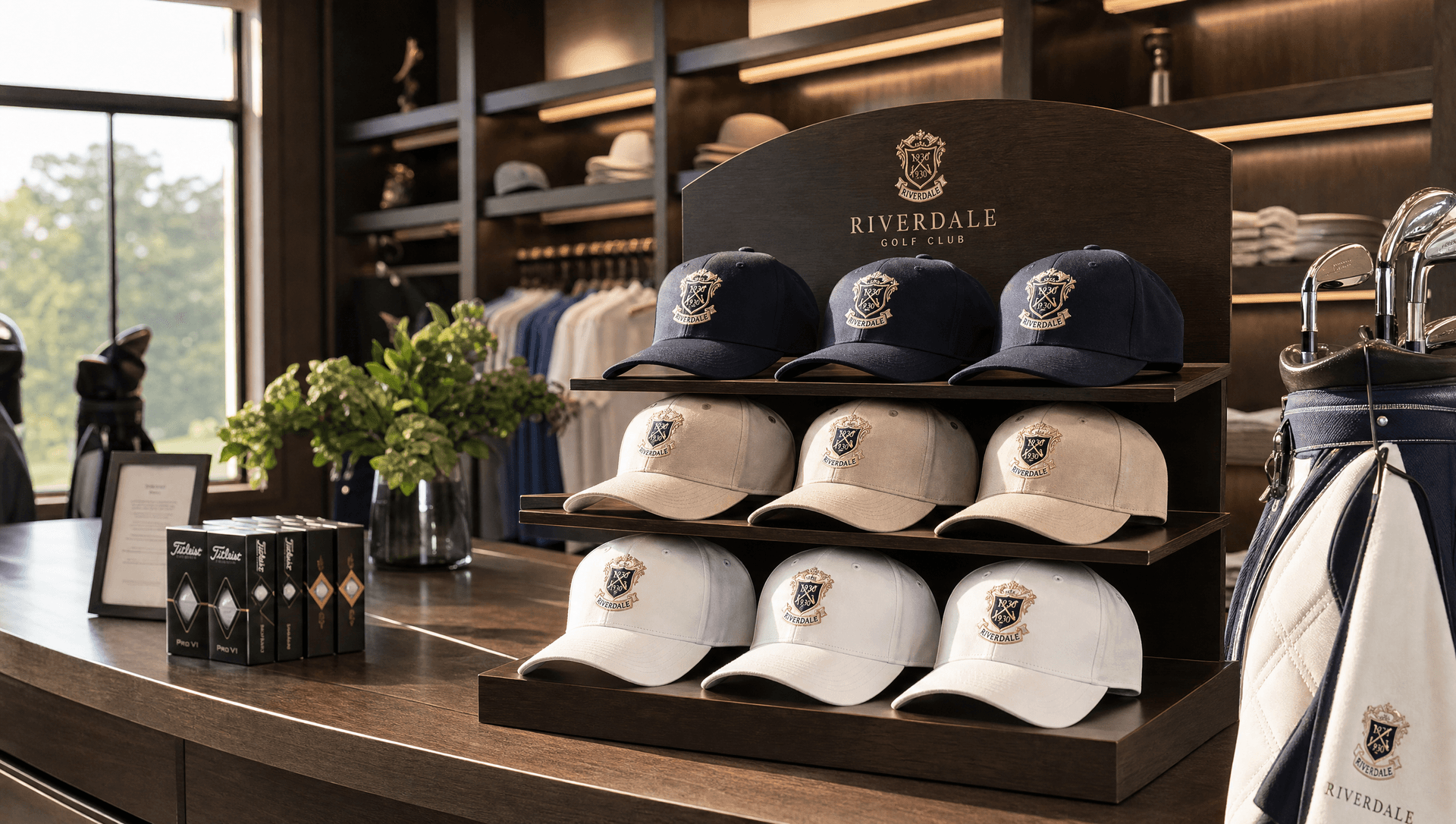
Caps first. The cap is the highest-visibility item in your range and the product members are most likely to wear off the course. It is also the most forgiving on sizing — one size fits almost all, which dramatically reduces stock-management complexity compared to apparel. A genuinely good club cap — embroidered, structured, UPF-rated — sells at $65–$79 and returns 67–70% gross margin. Members buy them as gifts, as replacements and as additions to a collection when the next seasonal colourway drops.
Polos second. The polo is the natural extension of a cap programme. It is more complex to execute (sizing runs, fabric selection, fit) and carries more stock risk, but at $79–$119 RRP and 35–45% gross margin it is a meaningful revenue line. The key is restraint: two or three SKUs in one or two colourways, not a full apparel range. Members will buy one or two polos per season. Overstocking kills the margin with markdowns.
Accessories third. Ball markers, towels and headcovers carry excellent margin (50–60%+) but low average transaction value. They work well as impulse purchases alongside a cap or polo but should not anchor a programme. Stock them because they complete the range, not because they drive the economics.
Rain jackets, bags and full apparel ranges come later. Do not start there. Get the cap right first, then earn the trust that justifies a broader range.
Margin maths explained plainly
Gross margin on merchandise is straightforward: (RRP minus landed cost) divided by RRP. “Landed cost” means the price paid to the supplier, delivered to the club, including any freight that is bundled in.
Here is a worked example using ClubCrew's pricing at the 100-cap tier:
- Landed cost for 100 caps: $2,050 ($20.50/cap)
- RRP per cap: $69
- Total retail revenue (100 × $69): $6,900
- Gross profit ($6,900 minus $2,050): $4,850
- Gross margin: 70.3%
That 70%+ gross margin is the ceiling a $39 cap at 20–25% margin cannot approach, even at twice the volume. The lesson: price the cap at what the quality justifies, not at what feels safe. A $69 cap your members actually want will outsell a $39 cap they tolerate.
Pre-order vs stock: when to use which
The pre-order model and the stock model serve different stages of a merchandise programme.
Pre-order is right for the first run and for any new product entering the range. Members express interest — and ideally payment — before the order is placed. The club is not funding inventory speculatively, so the risk of dead stock goes to near-zero. The trade-off: pre-order requires active member communication and a window of at least two to three weeks to collect commitments.
Stock is right for proven products once you have two or three seasons of demand data. If last year's cap moved 80 units in 12 weeks, ordering 100 for this season is a reasonable bet. Stock allows immediate purchase — walk in, buy, walk out — which captures impulse purchases and visitor sales that a pre-order model misses.
Most clubs run a hybrid: pre-order for the season opener to gauge demand, then maintain stock on proven sellers for reorders. That gives you coverage for both the risk-averse first run and the convenience-driven ongoing trade.
Seasonal cadence: why twice a year is the sweet spot
One merchandise drop per year is not enough to build momentum. Four drops per year is operationally burdensome for a small pro shop team. Twice per year — typically a season-opening release in March/April and a summer release in October/November — gives your programme rhythm without overwhelming the team.
The March/April drop captures start-of-season energy when member engagement is high. The October/November drop hits the pre-Christmas gifting window, when members buy for themselves and for others. Both windows have natural promotional hooks that require almost no effort to communicate — members are already engaged with the club calendar.
Once artwork is on file with a supplier like ClubCrew, repeat run logistics are minimal. No re-briefing, no new digitisation, no design delay. The seasonal cadence runs on its own rhythm and each drop builds on the last.
The quality threshold that changes everything
There is a threshold of quality below which club merchandise is invisible to members, and above which it becomes something they talk about. The cap that crosses the threshold is the one a member wears at another club and gets asked where they got it. That moment is the best marketing a merchandise programme can have. It costs nothing beyond the initial investment in getting the product right.
The threshold is not about price alone. It is about the combination of materials (structure, fabric weight, UPF rating), embroidery quality (depth, definition, wash durability) and design — artwork that reflects your club's actual identity, not a generic cap logo. A cap that scores well on all three will clear the threshold. One that cuts corners on any of them will not, regardless of the price tag.
The practical implication: do not accept samples you would not wear yourself to another club. If the cap looks like promotional merchandise, it will sell like promotional merchandise — which is to say, it will not sell at all.
Related reading
- The Australian Golf Club Pro Shop Margin Guide — the landed cost to RRP calculation for caps, polos and accessories, with the actual numbers.
- Embroidered vs Printed Golf Caps: Which Is Right for Your Club? — why decoration method matters more than most buyers realise at the brief stage.